Table of Contents
The events that unfolded in Baidoa now stand as one of the most consequential political turning points in modern Somalia. What began as a dispute over electoral models has culminated in a decisive federal intervention, with the central government successfully removing the regional leadership and installing an administration aligned with its national agenda. More than a localized conflict, this moment represents a direct and historic test between two competing visions that have shaped Somalia for over two decades: centralized authority versus decentralized clano-federalism.
Since the collapse of the Somali state in 1991 and the subsequent adoption of a federal framework in 2004, Somalia has operated under a delicate balance between Mogadishu and its federal member states. This arrangement was designed to prevent the re-emergence of authoritarian central rule while accommodating clan-based and regional power structures. However, it has also produced persistent ambiguity over where ultimate authority lies, creating a structural tension that has repeatedly slowed state-building efforts.
President Hassan Sheikh Mohamud entered this landscape with a clear objective: to unify the country under a one-person, one-vote electoral system and move beyond the indirect, clan-based model. Backed by several federal member states, including Southwest, Hirshabelle, Galmudug, and the Banadir administration, the federal government sought to create a coherent national framework for governance and elections ahead of the 2026 vote.
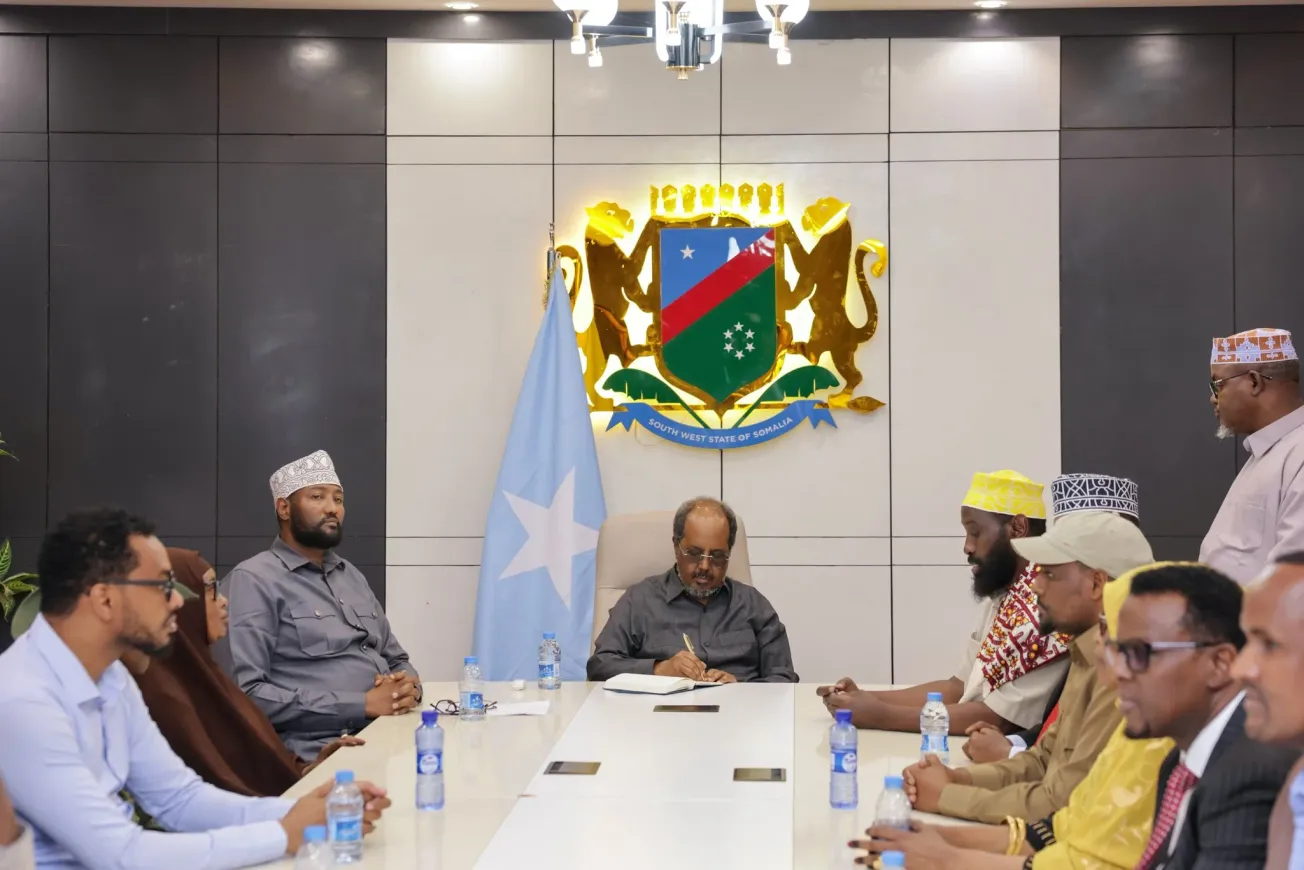
Southwest State, headquartered in Baidoa, was initially a key pillar of this effort. Its political weight made it central to the success of federal reforms. However, the alignment broke down when Southwest President Abdiaziz Laftagareen rejected the federal roadmap and moved forward with a hasty regional electoral process widely viewed as a self-extension of his rule. This act was not simply a political disagreement. It was a direct assertion of regional autonomy against a nationally coordinated reform effort.
The federal government’s response was quick and transformed the dispute into a defining confrontation. Troops were deployed through strategic corridors including Burhakaba and Daynunai, eventually advancing into Baidoa. The operation resulted in the removal of Laftagareen and the dismantling of the regional electoral structure he had overseen. In its place, a new transitional administration aligned with Mogadishu was established. The outcome was decisive. The federal government did not merely contest regional authority; it overrode it.
This marks the first time in Somalia’s federal era that the central government, backed by the Somali National Army (SNA) has exercised such direct and effective control over a member state. For years, the balance between federal and regional authorities had been managed through negotiation and fragile agreements. Baidoa represents a break from that pattern. It demonstrates that Mogadishu now possesses both the intent and the capacity to impose its will beyond the capital.
In this sense, the scenario in Baidoa goes far beyond the question of electoral reform. It represents a fundamental shift in Somalia’s political trajectory. The federal system established in 2004 emphasized decentralization as a safeguard against centralized abuse of power. Yet that same decentralization has often resulted in fragmentation, competing authorities, and stalled national progress. The inability to reconcile these tensions has been one of the central obstacles to Somalia’s state-building process turning the country into a place of perpetual anarchy.
The intervention in Baidoa suggests that the balance may now be shifting. The federal government’s success indicates a move toward a more centralized model of governance, where national priorities can be enforced even in the face of regional resistance. This does not mean that federalism is being abandoned, but it does signal a redefinition of its limits. Regional autonomy is no longer absolute when it conflicts with core national objectives.
At the same time, this moment should not be interpreted as a complete or uncontested victory for centralization. Federal member states such as Puntland and Jubaland have historically maintained strong autonomy and are likely to resist similar interventions. Their political and security structures present a different set of challenges, and it remains uncertain, if not improbable, whether the federal government could replicate the Baidoa outcome in those contexts.
This highlights the fact that Somalia is not simply moving from one system to another in a linear fashion. Instead, it is entering a formative phase in which the relationship between central authority and federal autonomy is being actively renegotiated. Baidoa is the first clear test of this shift, but it is unclear how it could play out in other regions.
The implications are profound. If the federal government can build on this momentum while maintaining legitimacy and inclusivity, it may finally overcome one of the most persistent barriers to national cohesion. A stronger central authority could enable more consistent governance, coordinated security, and credible elections across the country. However, if this approach is perceived as coercive or exclusionary, it risks provoking resistance that could deepen divisions rather than resolve them.
Ultimately, the outcome in Baidoa places Somalia at a crossroads. For the first time since adopting federalism, the country has witnessed a decisive assertion of central power over a federal member state the full backing of SNA. Whether this marks the beginning of a more unified national system or the start of a new phase of tension between Mogadishu and regional authorities will depend on how this power is exercised moving forward. What is clear is that the longstanding contest between centralization and decentralization has entered a new and defining stage.