Table of Contents
In late April, a familiar political ritual unfolded in Somalia. Traditional elders were invited to Mogadishu to attend the inauguration of one of their own, held on Sunday, April 26. What began as a ceremonial gathering quickly took on political significance, as both the government and opposition moved to court their influence.
The expectation was that elders could help bridge a widening divide between rival political camps. Both sides framed their outreach as an appeal to neutrality and tradition. Yet the very act of drawing elders into the center of a national political dispute exposed the limits of their role.
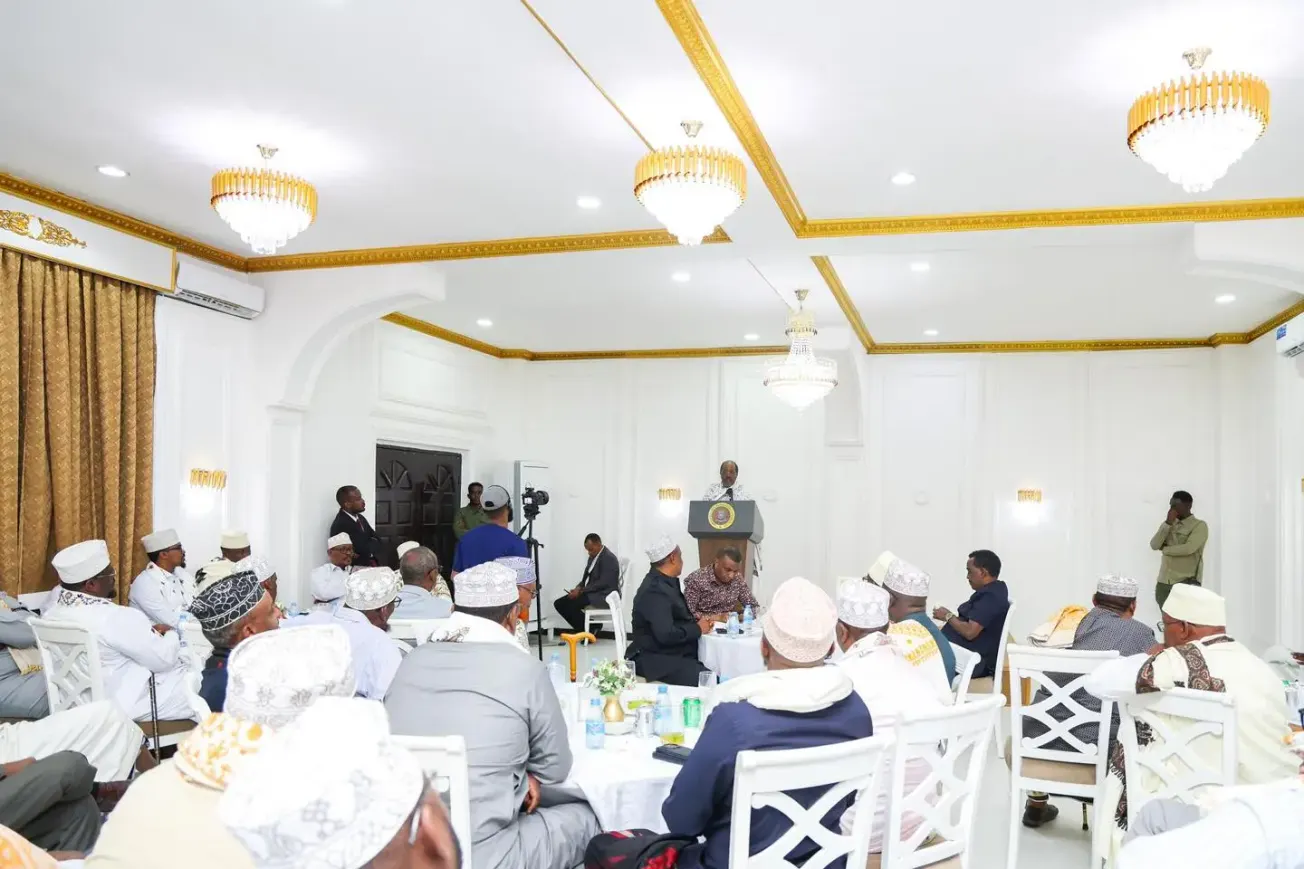
Once in Mogadishu, the elders were pulled into a familiar pattern. The opposition sought meetings to present grievances and win moral backing. The government hosted formal engagements, including a presidential dinner, to signal respect and build alignment. These parallel efforts did not unify the elders but instead divided them.
Some elders sided with the government, while others leaned toward the opposition. Their positions often reflected the interests of their respective clans and sub-clans. Rather than serving as a cohesive mediating body, the elders mirrored the fragmentation of the political landscape itself.
This outcome reflects a deeper structural reality. Traditional elders in Somalia derive authority from lineage and customary roles within specific communities. Their legitimacy is strong within those boundaries, but it does not easily translate into a national mandate that transcends clan affiliations.
The assumption that elders can act as neutral arbiters in national politics overlooks this limitation. Clan identity remains a central organizing force in Somali society, so the elders cannot simply step outside these identities when engaging in political negotiations.
At the same time, it would be a mistake to dismiss the role of elders altogether. Their involvement can be constructive when deployed at the right moment in the political process. The key distinction lies in whether they are asked to resolve a conflict or to legitimize an already negotiated outcome.
A clear example comes from 2012, during the adoption of Somalia’s transitional constitution. After extensive negotiations among political leaders and with strong backing from the international community, a constitutional framework was agreed upon. At that stage, elders were convened to be part of the process and later endorse the document rather than to negotiate it.
In that process, 135 recognized traditional elders played a central role in endorsing the agreement. Their participation helped confer legitimacy rooted in Somali tradition. The process was later expanded, with more than 800 delegates ultimately endorsing the constitution that remains in use today.
The success of that moment was not because elders resolved a political impasse. It was because the impasse had already been addressed through political negotiation and external support. The elders’ role was to validate and socialize the agreement across clan structures, not to create it.
This distinction is critical in understanding the current situation. In Mogadishu, elders were asked to step into an unresolved political conflict and act as mediators. Without a prior agreement or a unified political framework, their involvement became a source of division rather than cohesion.
Modern Somali politics operates within a hybrid system that combines traditional authority with formal institutions. Issues such as electoral processes, constitutional disputes, and power-sharing arrangements require technical expertise and institutional mechanisms. These are not areas where elders traditionally operate.
When elders are placed at the center of such disputes, they risk being seen as extensions of clan interests rather than neutral figures. This perception can deepen mistrust among political actors and complicate efforts to reach a resolution. It also places elders in a position where they are likely to be co-opted by competing sides.
The episodes surrounding post-April 26 inaugural ceremony underscores this risk. The elders’ intention to “narrow the gap” between the government and opposition was well meaning. Yet without a shared mandate or a pre-negotiated framework, their efforts lacked the foundation needed for success.
Somalia’s recurring political impasses are rooted in structural challenges that require institutional solutions. Strengthening electoral systems, clarifying constitutional arrangements, and building trust among political actors are tasks that must be addressed within the formal political arena.
Elders still have an important role to play, particularly in maintaining social cohesion and legitimizing agreements once they are reached. But expecting them to resolve national political crises on their own is unrealistic. Their authority, while significant, is inherently localized and trained on clan dynamics which contradicts national agenda at times.
The lesson from both 2012 and the recent events in Mogadishu is clear. Traditional elders are most effective when they reinforce consensus, not when they are asked to create it. Somalia’s path forward depends on recognizing this distinction and aligning roles accordingly.
In the end, balancing tradition with modern governance remains one of Somalia’s central challenges. Elders will continue to be respected figures within their communities. But resolving the country’s political impasse will require institutions and leaders capable of acting on behalf of the nation as a whole.